

For the past few years, we’ve periodically highlighted the elevated rate opportunity in long-term municipal bonds (munis) and how they can serve an important role within broader asset allocations. This paper will review our rationale and examine why the current window of relatively high absolute tax-exempt rates is attractive.
The way we think about bond portfolios is that they’re useful for 3 separate but interrelated reasons:
The most obvious role is to serve as assets throwing off sustainable income streams – what we call book yields, a major focus of our discussions with clients
Another is to act as ‘ballast’: fixed rate bonds, because of the semiannual interest payments, tend to feature less price volatility than growth-oriented assets like equities.
This means a fixed income sleeve combined with equities will typically dampen overall portfolio volatility while still positioning asset allocations to deliver long-term appreciation.
Finally, bonds can act as a source of readily liquid funds that can rapidly be redeployed into other risk assets when opportune moments arise (e.g. after an equity selloff).
When considering where to deploy capital, the task is clear: without compromising on credit quality, where’s the opportunity to achieve these objectives?
When allocating to fixed income, one of the decisions that must be made is which maturities to target. All bonds carry varying amount of duration risk, which refers to a bond’s price sensitivity to changes in interest rates. Simply put, all else equal the longer the maturity of a bond, the greater the duration and the bigger the price drop if interest rates increase. Conversely, if rates drop, the greater the bond’s price appreciation – it goes both ways.
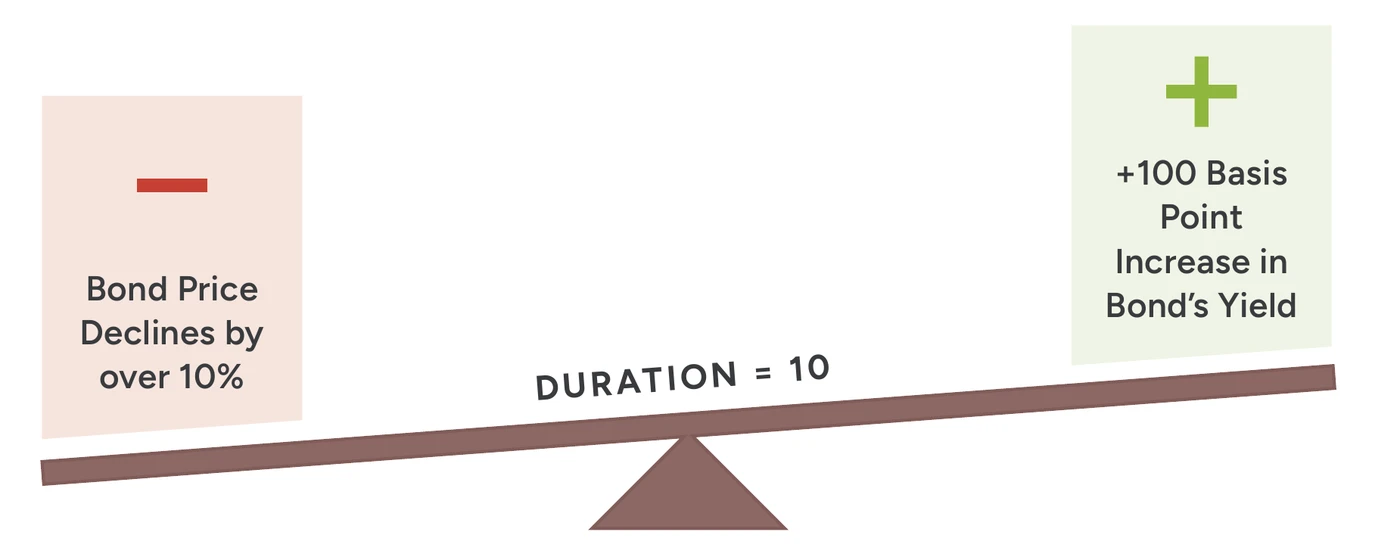
Sticking with shorter maturities means taking less duration risk, but this normally comes with the tradeoff of having to accept lower yields than those available from longer maturity positions. Conversely, extending maturities typically results in higher potential income, albeit at the price of taking on additional bond price sensitivity.
That is exactly the situation we find ourselves in today – long-dated munis are trading at significantly higher yields than their short-dated and intermediate-term counterparts. Is the current risk-reward tradeoff compelling? For all the reasons we’re about to discuss, the answer is yes.
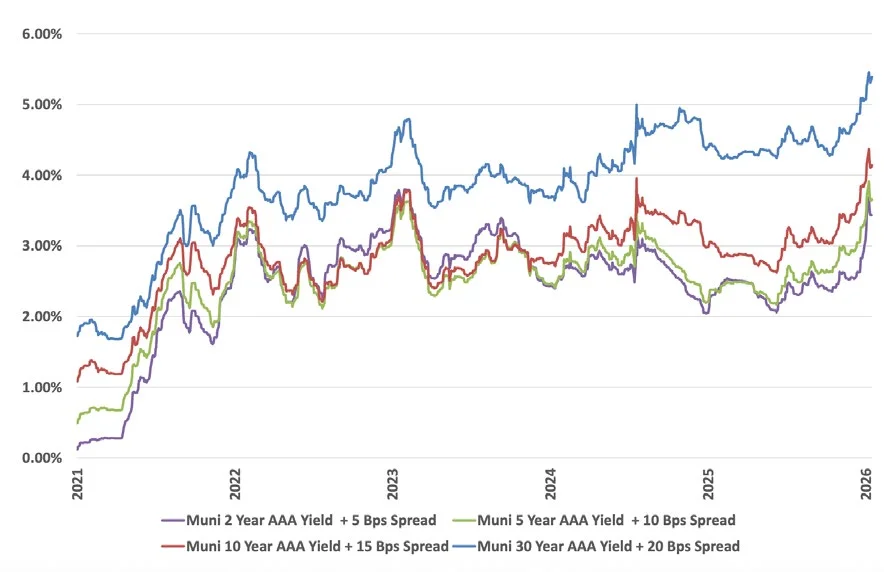
It’s vital to remember that munis carry features that incentivize prioritizing coupon income over price return.
Most muni bond interest is exempt from federal taxation (including the 3.8% supplemental Affordable Care Act surcharge on net investment income), as well as state and local income taxes if the muni issuer is located in the same state as the taxpayer (e.g. a NYC resident enjoys full tax exemption on interest payments received from any NY issued munis). The value of the muni tax-exemption scales positively with yields, such that the current higher municipal bond yields of 4.5-5% are equivalent to 9-10% fully taxable returns for investors in high tax states. Therefore, at current levels, the value of munis is in locking in the elevated tax-free yields vs seeking price appreciation from the bond.
| New York Muni Yield |
Taxable Equivalent Yield (Fed + NYS Taxes)* |
|---|---|
| 2.5% | 5.05% |
| 3.0% | 6.05% |
| 3.5% | 7.06% |
| 4.0% | 8.07% |
| 4.5% | 9.08% |
| 5.0% | 10.09% |
The bottom line is that munis may offer highly taxed investors incremental net yields than those offered by alternatives in the Treasury and corporate bond markets.
| Tax-Exempt New York Muni Yield |
Pre-Tax Treasury Bond Yield |
After-Tax Treasury Bond Yield |
After-Tax Muni Net Yield Advantage |
Pre-Tax Corporate Bond Yield |
After-Tax Corporate Bond Yield |
After-Tax Muni Net Yield Advantage |
|---|---|---|---|---|---|---|
| 2.5% | 2.5% | 1.48% | 1.02% | 2.5% | 1.24% | 1.26% |
| 3.0% | 3.0% | 1.78% | 1.22% | 3.0% | 1.49% | 1.51% |
| 3.5% | 3.5% | 2.07% | 1.43% | 3.5% | 1.73% | 1.77% |
| 4.0% | 4.0% | 2.37% | 1.63% | 4.0% | 1.98% | 2.02% |
| 4.5% | 4.5% | 2.66% | 1.84% | 4.5% | 2.23% | 2.27% |
| 5.0% | 5.0% | 2.96% | 2.04% | 5.0% | 2.48% | 2.52% |
Let’s lead with a counterexample. From roughly 2016 through Q4 of 2022, the yields available on long-dated municipal bonds were abysmally low, and as a result we aggressively limited maturities in client bond portfolios. Although measures of relative value, such as muni vs Treasury ratios indicated good relative value, the price risk was not worth extending maturities.
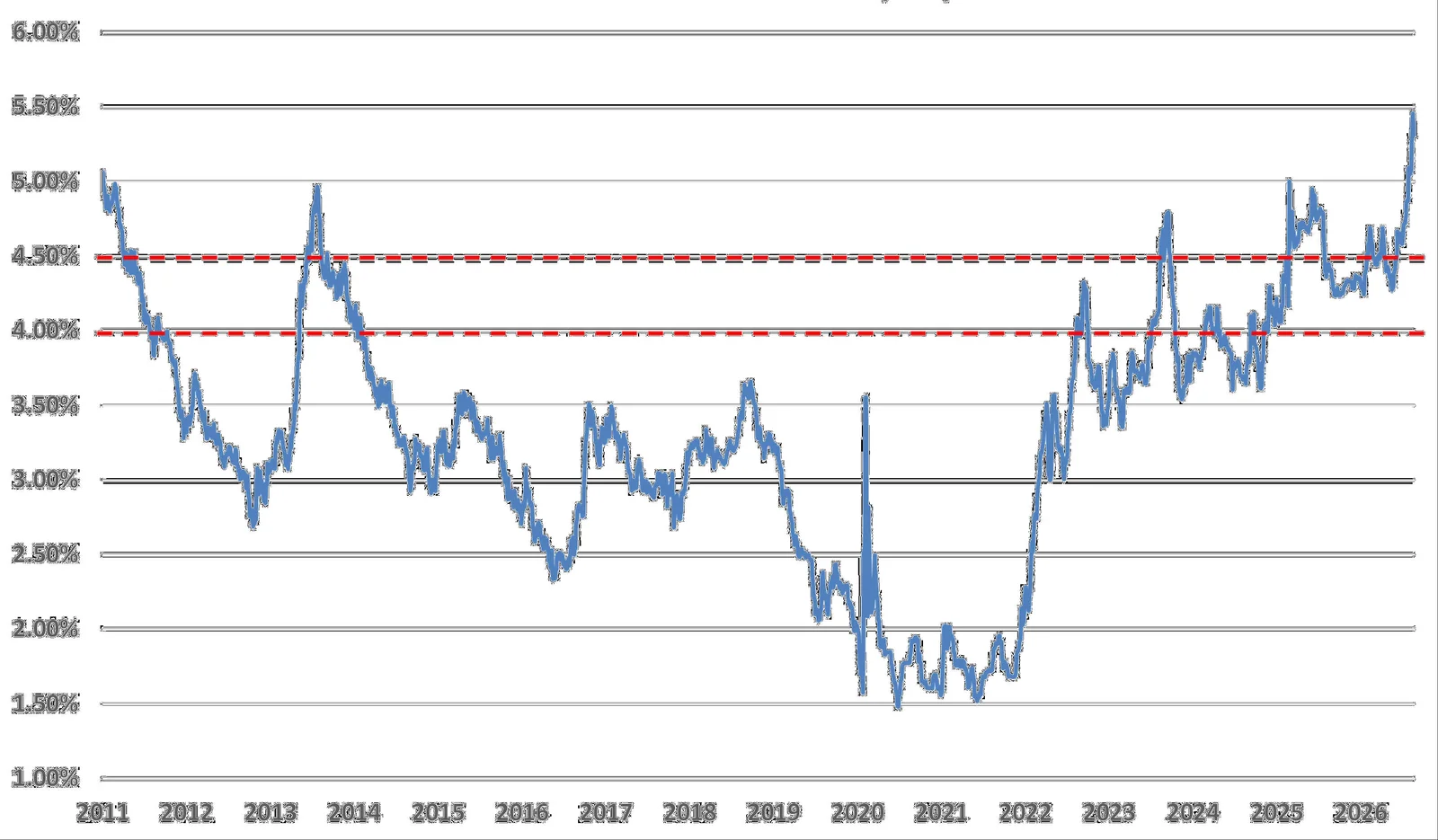
As an example, at 2.5-3% yields on long-term munis, a 100 bps (1%) rise in yields means it takes 4-5 years of coupon income to offset the decline in the bond’s price. But the math changes with today’s higher rates of 4.5-5%. For that same 1% rise in rates, the recurring coupon income is more than enough to offset price declines within just 2-3 years. Meaning, at current levels, the income return is highly effective in offsetting price declines.
That’s the key – as long-term oriented investors, we’re committing capital for the future in investment grade, high-coupon bonds that we’re happy to hold until they’re called or mature at par. Price volatility will come and go, but ‘clipping the large coupon’ that’s worth the equivalent of 8-10% pre-tax is the opportunity.
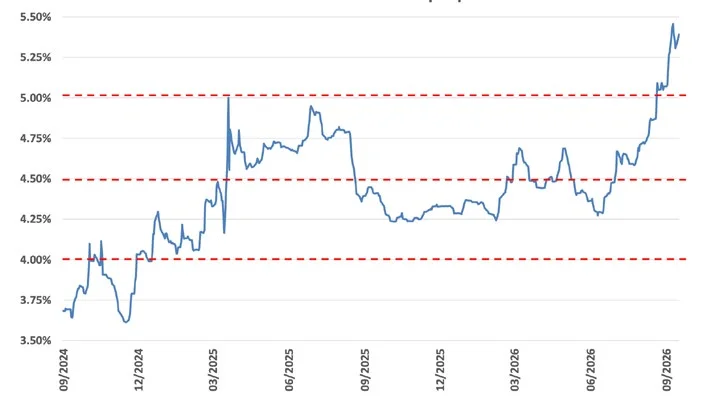
One question that still needs to be addressed is “Why?” Specifically, why have long-dated municipal bond yields stayed high (and attractive) since 2025?
The simplest answer is also the most readily apparent: muni yields are sharply higher because base rates across fixed income have spiked in recent weeks. Munis will typically ‘tag along’ with rate moves in other, larger fixed income markets (most notably those in Treasuries). Think of it as akin to gravity; munis and other fixed income assets ultimately orbit the massive Treasury market and react to developments happening there.
The spike in Treasury rates has several contributing factors, including:
Elevated inflation readings stemming from energy supply shocks (Strait of Hormuz crisis) and growing bottlenecks for several major commodities (fallout from the Russia/Ukraine war)
Renewed market jitters about the huge and growing Federal deficit, and the resulting growth in the stock of Treasury debt
Relatedly, massive net new issuance of new debt from both the US government and companies levered to the ongoing AI buildout
Idiosyncratic selling of Treasury debt due to country-specific initiatives (e.g. the Japanese government raising funds needed to help prop up the yen).
Finally, real economic growth appears strong and firing on all cylinders - a textbook catalyst for higher yields
Overall, we feel these issues are largely priced into current base rates and current levels represent an opportune moment to add munis.
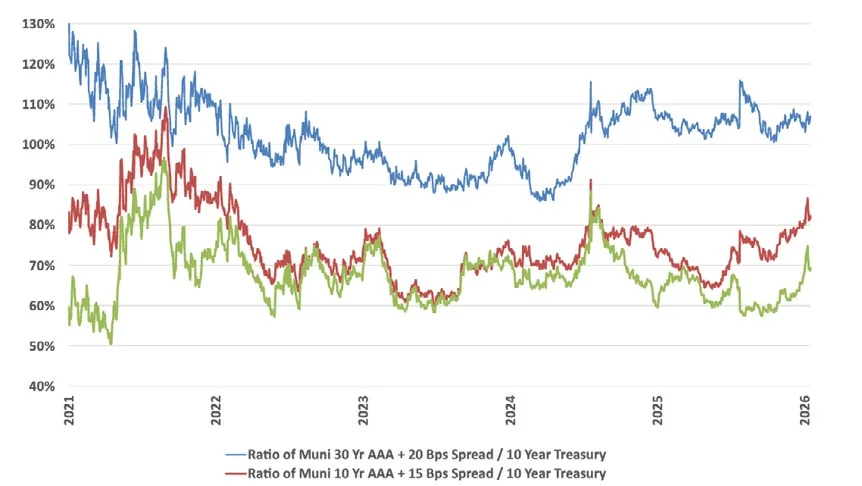
While the rates on Treasuries, corporate bonds, and munis alike have all spiked, long-term munis are particularly attractive on a relative basis (as shown in the following chart comparing muni vs Treasury bond yield ratios). As you can see, those muni yields are over 100% of Treasuries, signaling astounding value given their status as historically safe assets that are federally (and often state/local) tax-exempt. It’s not often that investors can add munis at yields greater than a taxable counterpart.
The answer to why long-term municipal bonds are also comparatively cheap is a bit more nuanced. We believe the root cause comes from the influence of technical factors. In the past munis overwhelmingly used to be held either directly by individuals (classic ‘mom and pop’ direct buy-and-hold) and banks/insurance companies, or collectively via large traditional mutual fund pools.
In the past several years the holders mix has shifted noticeably, with each of these sources losing significant market share. This matters because different buyer types typically tend to favor different parts of the curve when deploying their capital.
The largest decliners in market share – mutual funds, banks, and insurers – are traditionally the largest natural buyers of long-dated muni bonds.
Meanwhile the largest gainers of market share – professionally-managed Separately Managed Accounts (SMAs) and ETFs – overwhelmingly tend to favor much shorter maturity structures (SMAs) or are often passively managed and don’t actively seek to find the best value along the yield curve (ETFs).
That’s exactly how we don’t seek to manage our clients’ municipal bond portfolios – we actively try to capture the best absolute and relative values in the market.
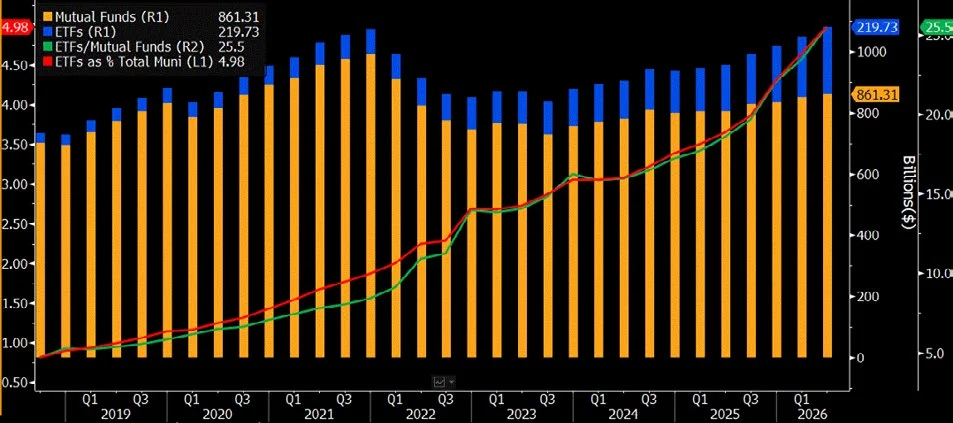
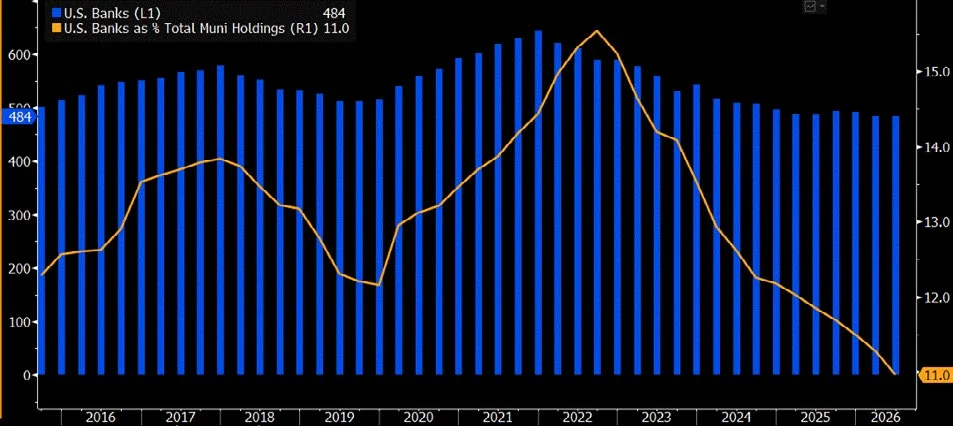
To summarize, the demand for long-dated municipal bonds has suffered primarily because their largest traditional purchases have lost some of their firepower. Issuers have thus been forced to employ the most basic natural market solution to a classic supply/demand imbalance - sweeten the yields on longer dated munis to entice sufficient buyers!
Looking forward, we don’t think this imbalanced supply-demand dynamic will persist indefinitely. To our thinking, the more powerful secular trend that will eventually assert itself lies at a higher level.
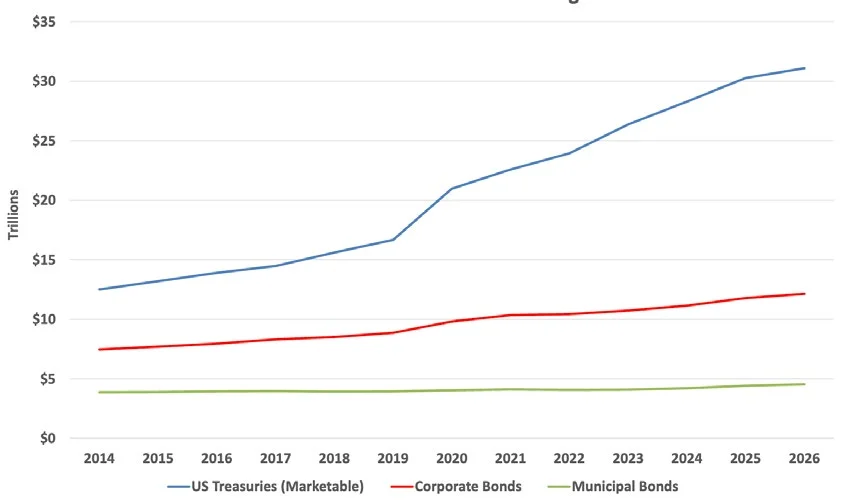
Over the past 10+ years the amount of US dollar-denominated fixed income assets has exploded. But the details matter:
Since 2014 marketable US Treasury debt has increased from $12.5 to $31.1 trillion (an 8.25% compound annual growth rate, or ‘CAGR’)
Similarly, corporate bonds outstanding have increased from $7.5 to $12.1 trillion (4.3% CAGR)
But over the same timeframe the municipal bond market has gone from $3.85 to just $4.5 trillion (1.4% CAGR)
The muni bond market simply hasn’t kept up with the growth to its closest fixed income alternatives.
Meanwhile, with the amount of wealthy Americans increasing each year, an aging population, and a likely upward trajectory in tax rates, the aggregate demand for reliable tax-exempt income is likely to increase. This secular bid is set to become an ever more apparent force within the muni market in the years ahead.
Keep things simple and in proper perspective. At these absolute levels, long-term munis can durably capture a stable, liquid, and tax exempt income stream that on an after-tax basis that compares favorably to the historic long term pre-tax returns on equities.
Speaking of equities, the S&P 500 has increased over 100% since the beginning of 2023. Some investors throughout this impressive bull run may be sitting on what has grown into outsized exposures to stocks due to the resulting allocation creep. Fortunately, today’s long-dated municipal bond rates offer a suitable investment to rebalance portfolios and diversify return streams.
From our point of view as experienced investment professionals, establishing a bedrock sleeve of strong income-generating assets in a muni portfolio enables us to allocate the remainder of a client’s capital to other risk assets more suited for long-term price appreciation. That ballast acts as a strong foundation to a carefully constructed asset allocation.
At current levels, we’re not dependent on bond price appreciation from declining rates for our thesis to hold. Although that would be a welcome added benefit to the portfolio’s total returns, the locked-in elevated tax free income stream is the center of our focus.
It’s uncomfortable putting money to work while rates are still rising. But a bell doesn’t ring at interest rate tops. It’s always best to leg into rising rate environments, especially once sentiment’s grown overly pessimistic and further increases are largely baked into the popular narrative.
We also think this rate move is getting close to its ultimate top for the cycle, the reason being that if the 10-year Treasury yield actually begins approaching 5.75-6.00%, it’s likely to spur an economic slowdown which subsequently leads to lower rates.
Our bottom line: we’re ringing the bell on munis.