

As we inch closer to the fourth quarter, yields have drifted higher across the curve. Here’s how we’re currently positioning client portfolios in the current rates market.
The yield curve has evolved significantly over the past year, as economic fundamentals, geopolitics, and consensus predictions of Fed actions shifted in tandem.
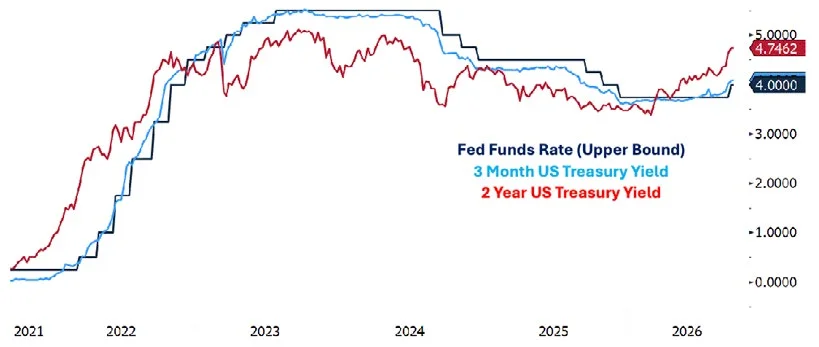
A year ago, the yield curve was sharply inverted as markets assumed multiple Fed rate cuts were on the horizon. For short-term investors, this meant accepting a lower income return for tying up money for longer periods vs. taking their chances with shorter maturities.
By the start of 2026 expectations had changed noticeably, resulting in a relatively flat curve as front-end inertia was instead baked into yields.
Today we’ve gone full circle and are back to a ‘normalized’ upward sloping curve as markets now anticipate additional rate hikes after the FOMC’s 25 bps September bump.
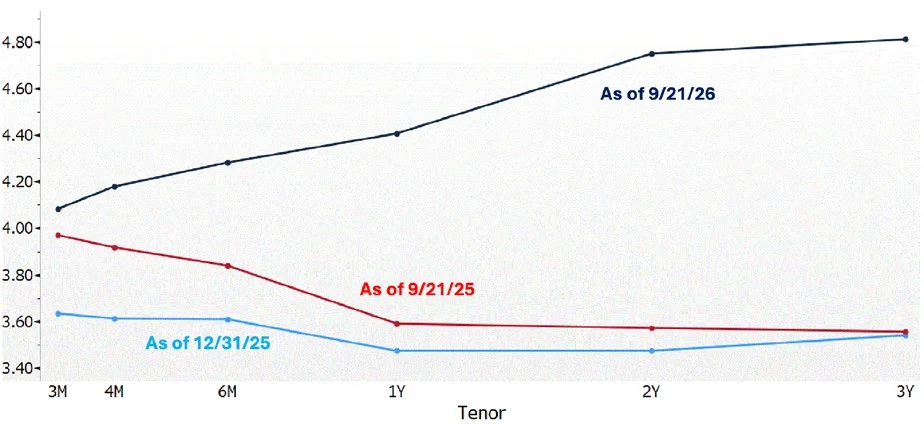
Both qualitative and quantitative factors have driven these changes. The qualitative aspect is simple – there’s a new sheriff in town, and the market’s trying to predict Chair Warsh’s decision making. Thus far he seems committed to overhauling the Fed’s post-Great Financial Crisis communication style, which over the past nearly two decades has emphasized explicit forward guidance (arguably at the cost of restricting flexibility in responding to evolving conditions).
Specifically, Chair Warsh believes this has attenuated the market’s feedback loop, with ‘Fedspeak’ guiding the rates market’s evolution rather than the other way around. His goal is to reduce the outbound flow of information, so that clearer, less distorted market signals can help the Fed judge how policy is faring and how it might need to change going forward. This doesn’t necessarily mean Fed officials won’t have any guidance or communication at all – more specifics will unfold after Chair Warsh’s various ‘special task forces’ evaluating key Fed practices formulate their conclusions.
We expect changes in communication and Fed behavior. Specifically, given Chair Warsh’s history, the Fed will focus on their dual mandate - the evolving health of the labor market and inflation. This sounds awfully familiar to my earlier days on Wall Street when we didn’t have forward guidance, dot plots, or post-meeting press conferences. We invested capital based on the balancing act between the price of money and employment data and tried not to overthink things at every turn.
What’s old will be new again. We’re ok with that.
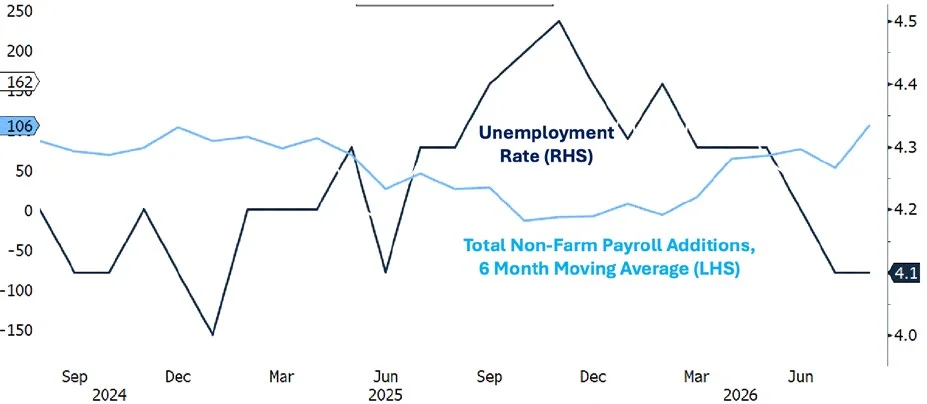
Speaking of the data, the ‘easy’ analysis lies with the state of labor markets, which remain very healthy.
Today’s market debate is focused on the ‘stable prices’ side of the Fed’s dual mandate. Both headline CPI and the core PCE index (the Fed’s preferred inflation measure) are running above their 2% targets. Normally, along with the healthy jobs landscape this factor alone would be sufficient to justify raising rates to get inflation under control.
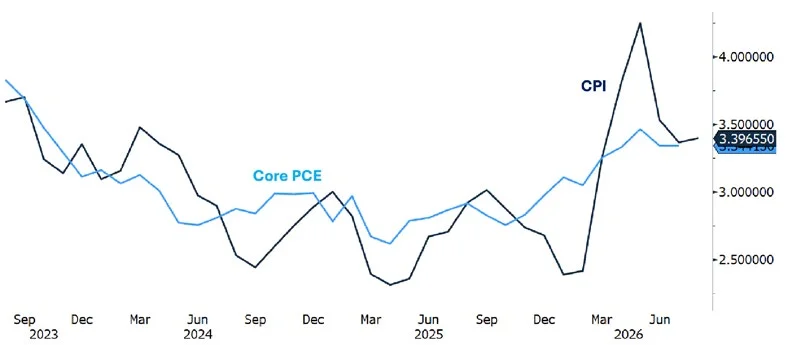
But rate hikes are a blunt instrument that may not be effective in tamping down the primary causes behind higher prices, especially in our current situation. For rate hikes to act as an effective medicine, they need to have an impact on the underlying disease. There’s a strong case to be made that a series of exogenous one-time shocks – tariffs, oil price spikes, the Russia/Ukraine conflict throttling the supply of key agricultural commodities, etc. – are what’s causing elevated inflation readings. These factors typically don’t respond to interest rate impulses (e.g. the Saudi Arabian East/West pipeline won’t be spared drone strikes because the Fed Funds rate ticked higher) and may not persist indefinitely (e.g. tariffs can be suspended).
Further supporting this viewpoint is the fact that other inflation measures, such as core CPI and the Dallas Fed’s trimmed mean calculation (which strips out outliers on either side of the underlying trend), are running much cooler and close to the 2% target. Pick your dataset, choose your narrative and set your interest rate policy?
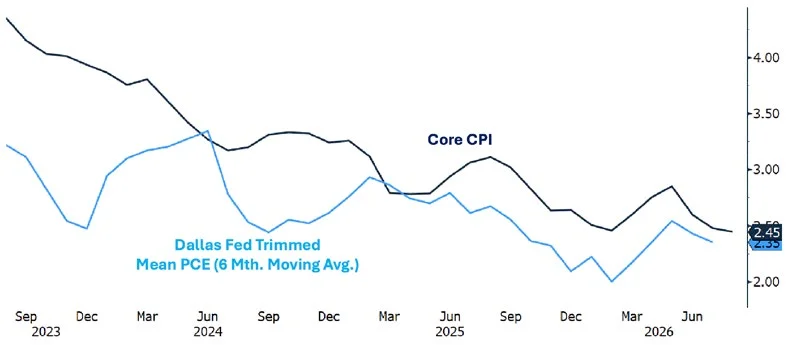
The picture is noisy right now, but to us the economic backdrop looks like a case where simply looking at data trends doesn’t do a good job of telling the entire story.
Current bond market sentiment is decidedly gloomy – inflation is perceived as being stuck at an elevated level, the Federal deficit requires ever-more Treasury bond issuance, hyperscaler corporate bond issuance is unabated, etc. Many find it difficult to imagine a near-term catalyst which would result in a pivot to a falling rate environment anytime soon.
Consider all this while remembering a bell never rings at interest rate tops. It’s always best to leg into rising rate environments, especially once sentiment’s grown overly pessimistic and further increases are largely baked into the popular narrative. Once that point is reached the risk-reward shifts in corporate cash investors’ favor - higher yields with lower durations combining to rapidly mitigate any price changes due to incremental interest rate rises.
For example, imagine a shock where rates quickly spiked 50 basis points. The unrealized book loss on 2- and 5-yr Treasury positions at today’s yields would be roughly 1% and 2.25% respectively, but the >4.5% annual cash flows from their coupon income would continue to accrue and more than offset this price decline.
On that basis, can you hear the bell ringing? It’s time to extend maturities – the Fed just tightened and a hiking bias is built into today’s elevated rates and upward-sloping curve.
Expect further Fed action to establish the new regime’s credibility and let the ‘bond vigilantes’ know there’s a new sheriff in town. But it’s important to look past the headlines and understand that this may not lead to somewhat higher yields because additional FOMC action is already baked into today’s levels. As a result, any further Fed tightening is unlikely to lead to lockstep increases in 1-3 year rates precisely because market expectations have already calibrated for additional hikes.
But in the meantime, we’re in an environment where money market funds are yielding 3.70-3.75% but going out longer on the curve nets bonds with 4.50-5.25%+ yields. The rewards for moving out of cash and very short bills are already real and tangible. From a practical standpoint the downside risks are comparatively small and manageable, particularly since the benefits of elevated income returns compound positively with time spent invested.
In our preceding 30+ years of managing corporate cash portfolios, we’ve rarely been able to buy ‘clean’ 5% book yields on high grade corporate bonds like those available in today’s market. The bell is ringing.